
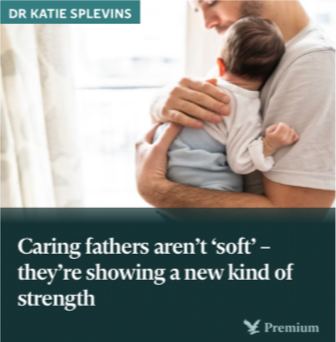
Caring fathers aren’t ‘soft’ – they’re showing us a new kind of strength
If we’re serious about tackling ‘lost boys’, toxic influencers and men’s mental health, the answer may not be found in therapy or classrooms,
says Dr Katie Splevins – but in the nursery

3 minute read
Life-Work: Parenthood as an Untapped Leadership Opportunity
Dr Katie Splevins | Clinical Psychologist | © 2025
Published: July 2025
Why this matters?
Parenthood is often seen as a career interruption - time out, a setback. In reality, it can be the opposite. Parenthood is one of the most powerful, yet least recognised, developmental routes into leadership.
This is not about transferring a few “parenting skills” into the workplace. It is not a metaphor - it is a developmental process grounded in neuroscience, evolutionary theory and clinical practice.
For birthing parents, hormonal changes during pregnancy trigger long-lasting adaptations in brain regions involved in empathy and social cognition.
For non-birthing parents - and for anyone providing consistent, emotionally engaged care - structural and functional brain changes can emerge through the act of caregiving itself. Proximity and hands-on time strengthen these changes that support bonding, empathy, and social cognition.
A growing body of evidence suggests that all humans are predisposed to caregiving, reflecting our evolutionary history of cooperative childrearing, where many adults, not just mothers, contributed to raising children.
Leadership develops in many ways. Parenthood is not the only pathway, but it is a powerful but often overlooked one. When it’s treated as ‘time away’ rather than a developmental stage, organisations miss the chance to grow the leaders they say they need. The structural and emotional changes triggered by caregiving can leave new parents feeling vulnerable and overwhelmed but they can also create real potential for growth - if parents and organisations have the right support to harness it.
Where parenting and leadership skills overlap
Parenting and leadership overlap in striking ways. Both demand:
Empathy and perspective-taking – understanding others and holding the bigger picture
Steadiness under stress – managing yourself when others depend on you
Boundaries with warmth – guiding warmly and firmly, without fear or harshness
Motivating growth – encouraging others to step forward, stumble, and learn
Resilience and adaptability – recovering when plans unravel
Compassion – the motivation to notice and alleviate struggles
Researchers have described parenting as a developmental pathway into transformational leadership (Popper & Mayseless, 2003; Gartzia, 2023).
Neuroscience increasingly shows that caring for children reshapes adult brains and bodies – creating potential for profound growth in empathy, regulation and connection (Feldman, 2015; Abraham et al., 2014; Gettler & Kuo, 2019).
These same skills - emotional regulation under pressure, perspective-taking, and compassionate resilience - are core attributes of transformational leadership (Popper & Mayseless, 2003).
My contribution
In my NHS work, I developed and delivered an adaptation of a Compassion-Focused Intervention for parents in a UK Mother & Baby Unit - one of the most demanding contexts for caregiving and psychological growth. I have since adapted this approach to support leaders navigating major transitions including parenthood:
This approach helps to:
Reduce shame and self-criticism – by making sense of the profound changes being experienced and distinguishing what is our evolved nature from our human responses.
Stay grounded under pressure – re-balancing of the three emotional regulation systems, enabling “bigger picture” thinking even when stress is high.
Strengthen flows of compassion – from others, to others, and for themselves, protecting against burnout and building resilience
The result is more confident, emotionally intelligent, and compassionate parents. Babies benefit through stronger bonds and more attuned care. And critically, these same capacities are the ones organisations identify as essential for effective leadership.
“Katie’s guidance helped me navigate fertility treatment while continuing in a demanding role. I could not have become the senior leader I am today - or the calm, compassionate person I’ve become - without her support.”
Rebecca, Senior Programme Manager, NHS England.
The opportunity
FOR PARENTS: Growth doesn’t come from leave alone. It comes from understanding the hormonal, brain, and emotional changes underway - and having the right support to harness them. With that support, challenges that feel overwhelming can become opportunities for personal, caregiving and leadership growth.
FOR ORGANISATIONS: This isn’t just about time away from work. It is rooted in the science of human development. When policies and frameworks are informed by neuroscience and our evolutionary understanding of caregiving, they become far more effective. Practical steps - such as non-transferable and extended leave, tailored support for new and returning parents, access to psychological support, flexible working, and reflective spaces – help ensure leave is recognised as a profound developmental stage that strengthens families and grows future leaders.
FOR SOCIETY: Humans evolved to raise children in shared networks of care. When caregiving is inclusive and supported, birthing parents are less overloaded and more likely to return to work. Non-birthing parents reclaim a vital heritage. Adoptive and foster parents and wider family are recognised, children thrive - and workplaces redress the gender balance and gain leaders who are more empathetic, collaborative and resilient.
In summary
Parenthood is not the only route to leadership development, but it is one of the most powerful and too often overlooked. With the right support parents and caregivers can use this transition to grow into more compassionate, self-aware, and courageous leaders - while giving babies and the next generation the best possible start.